

The Community of Coleraine
Where are we?
Coleraine (from the Irish: Cúil Raithin meaning "ferny corner") is a large town in County Londonderry, Northern Ireland near to the mouth of the River Bann. Coleraine is situated at the lowest bridgeable point of the Bann, where the river is a quarter of a mile wide. The town square is called 'The Diamond' and is the location of the Town Hall. St. Patrick's Church of Ireland is situated nearby. The University of Ulster campus was built in the 1960s but is one of the better pieces of architecture from that era and has brought a high quality theatrical space to the town in the form of the Riverside Theatre, where the quality of production often belies the small size of the town.
Coleraine is the main town of the world famous Causeway Coast,. The world famous Giant's Causeway is a twenty–five minute bus ride away. The distillery village of Bushmills is well-served by buses from the town and there is a narrow-gauge steam train running in the summer from Bushmills to the Giant's Causeway. The train journey takes approximately fifteen minutes from the town to the Causeway. Also north of Coleraine is the spectacularly scenic coastal town of Portstewart, with fine sandy beach and coastal walks.
North-west of Coleraine lies the small village of Castlerock, with a beach which is essentially a continuation of the beach at Portstewart, separated by the River Bann. Also nearby is the huge beach at Benone Strand and Mussenden Temple, built by Frederick Augustus Hervey, an 18th century Anglican bishop atop a precipitate cliff and overlooking County Donegal in one direction and Scotland in another. The National Trust managed Downhill forest was part of the Bishop's Palace, and although the Palace itself is now a ruin the gardens are a wonderful place full of strange hidden lakes and gloriously tended flower gardens.

Iconic image of NI - the Giant's Causeway

WHERE WE ARE
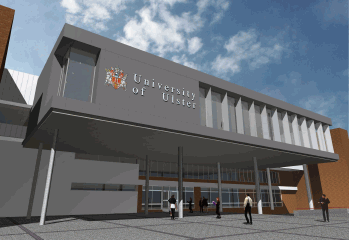
University of Ulster at Coleraine
What do we do?
The Coleraine Bahá’í community is outward-looking, committed to sharing a basic message of religious understanding and human unity, and to helping build a better world. World-wide they number several millions, and are drawn from every social, racial, and religious background. Coleraine Bahá'ís are active both in community service and in the development of a spirit of tolerance and fellowship between all Faiths. They participate and hold interfaith prayer meetings, attend interfaith workshops, speak at schools assemblies on Bahá’ís Holy days and are committed to community growth and development.
Activities include devotional meetings for prayer and meditation, open discussion groups, organised courses for moral and spiritual development, children’s classes, and special projects for young people. These are all open to everyone, of any or no religious persuasion.
The Bahá’í Society at the University of Ulster has, held international evenings, dawn picnics, walks, talks on social and economic development, international justice and learning from disaster among many other themes. There have been discussion evenings on health, meditation and prayer sessions as well as musical devotionals.
"Consort with the followers of all religions in a spirit of friendliness and fellowship" Bahá'u'lláh
What we believe
The Bahá'í Faith is the youngest of the world's independent religions. Its founder, Bahá’u’lláh (a title meaning “Glory of God”) (1817-1892), is regarded by Bahá'ís as the most recent in the line of Messengers of God that stretches back beyond recorded time. In just over a century-and-a-half it has established itself as the world's second most widespread religion (after Christianity) and it is now the eighth-largest organized religion (these statements come from non-Bahá'í scholars, by the way, not from us).
The central theme of Bahá'u'lláh's message is that humanity is one single race and that the day has come for its coming together in a global society based on justice and cooperation. Historical forces are breaking down traditional barriers of race, class, creed, and nation and that will, in time, give birth to a universal civilization. The main challenge facing the peoples of the earth is to accept the fact of their oneness and to work together.
For more than a century, Bahá'í communities around the globe have been working to break down barriers of prejudice between peoples and have collaborated with other like-minded groups to promote the model of a global society. At the heart of our belief is the conviction that humanity is a single people with a common destiny. In the words of Bahá'u'lláh, "The Earth is but one country, and mankind its citizens."
There are no Bahá'í clergy or leaders, the community is administered at all levels by elected bodies. All members have a say in the work of community and play their part. To learn more about the Bahá'í Faith and its teachings and see something of its activities world-wide in the section below.
Or to learn more you can contact us at bcni@bahai.org.uk.


Find out more

The Bahá'ís of the Republic of Ireland
The Bahá'ís Worldwide Community


The Bahá'ís of the United Kingdom