
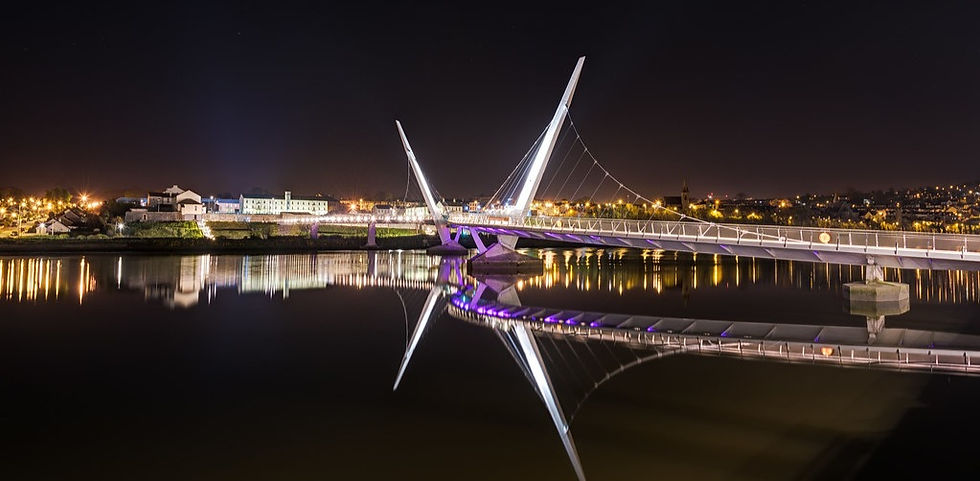
The Community of Derry-Londonderry


Where are we?
The city known variously as Derry and Londonderry is one of the largest in Ireland and is the hub of its district. Placed at a strategic crossing point of the River Foyle it has been an important site for thousands of years. The original name Doire means "a grove of oak trees" in the Irish language. Such places were sacred to the pre-Christian Celts who inhabited Ireland. Later it became an important Christian settlement. In 563 C.E. Columb (Columba), Abbot of Derry, left to carry the message of Christianity to the people of Scotland and played a key role in evangelising that country. His tomb and monastic foundation on Iona are among Scotland's most revered religious sites.
In the Seventeenth Century the city was developed with money invested by the city guilds of London, and Derry officially became Londonderry, although to this day the older name is the one more generally used. The defence walls round the city protected it during the siege of 1689-1690, a key episode in the war between King James Stuart and the man who finally replaced him on the throne of Britain and Ireland, his son-in-law William of Orange-Nassau.
Just as the "Derry's Walls" are preserved largely intact to this day - one of the few remaining examples of an entire city wall, and of great historical value - so too, sadly, are the tensions and religious divisions which they came to represent, though great progress towards community reconciliation has been made in recent years. The Bahá'ís are among the groups trying to heal the divisions.
However there is more to the area than the city with its 100,000+ population. Derry is backed by a rural area of gentle green hills and the flat land on the shore of Lough Foyle where the river of that name (that passes through the city) enters the sea. There are a number of villages, while across the Irish border the hills of Inishowen are clearly seen, providing a backdrop to the city's already-impressive natural setting.
In recent years Derry has become an important tourist destination, a centre for festivals and a base for visitors who want to explore the beauty and attractions of the surrounding areas or just to experience the history and diversity of this vibrant city. An increasing number are interested in its spiritual heritage: its connections with ancent Celtic spirituality and its lasting influence as the religious settlement of St Columb (Columba), the future evangelist to Scotland. There is a local "Columba Trail" with walks taking in the various sites associated with the saint, and Derry is also one end of a much longer Trail that follows him into Scotland and places associated with him there.

Who are we?
The world-wide Bahá'í Faith has had a presence in Ireland since before the First World War. The Spiritual Assembly of the Bahá'ís of Derry-Londonderry is the elected administrative body for the members of the Bahá'í Faith in this city in the north-western part of Northern Ireland. The first Spiritual Assembly of the city was elected in 1971 and it has remained in existence since then.
Here as elsewhere the Bahá'í community is notable for the diversity of its membership. Their wide range of backgrounds is in keeping with the "unity in diversity" which is such a characteristic of the Bahá'í Faith.
Many people in Derry have great difficulty in even understanding that there is more to the world than Protestants and Catholics. Indeed these two branches of the Christian religion are often called "two faiths" - the first misunderstanding which the Bahá'ís try to put right. The Bahá'ís in Derry are active in a wide variety of activities. They are a religious community that looks outwards.
What do we do?
The Bahá’ís an outward-looking community, committed to sharing a basic message of religious understanding and human unity, and to helping build a better world. World-wide they number several millions, and are drawn from every social, racial, and religious background. Derry’s Bahá'ís are active both as a community and in the wider society in pursuit of these aims.
Activities include devotional meetings for prayer and meditation, open discussion groups, organised courses for moral and spiritual development, children’s classes, and special projects for young people. These are all open to everyone, of any or no religious persuasion.



Find out more

The Bahá'ís of the Republic of Ireland

The Worldwide Bahá'í Community

The Bahá'ís of the United Kingdom